
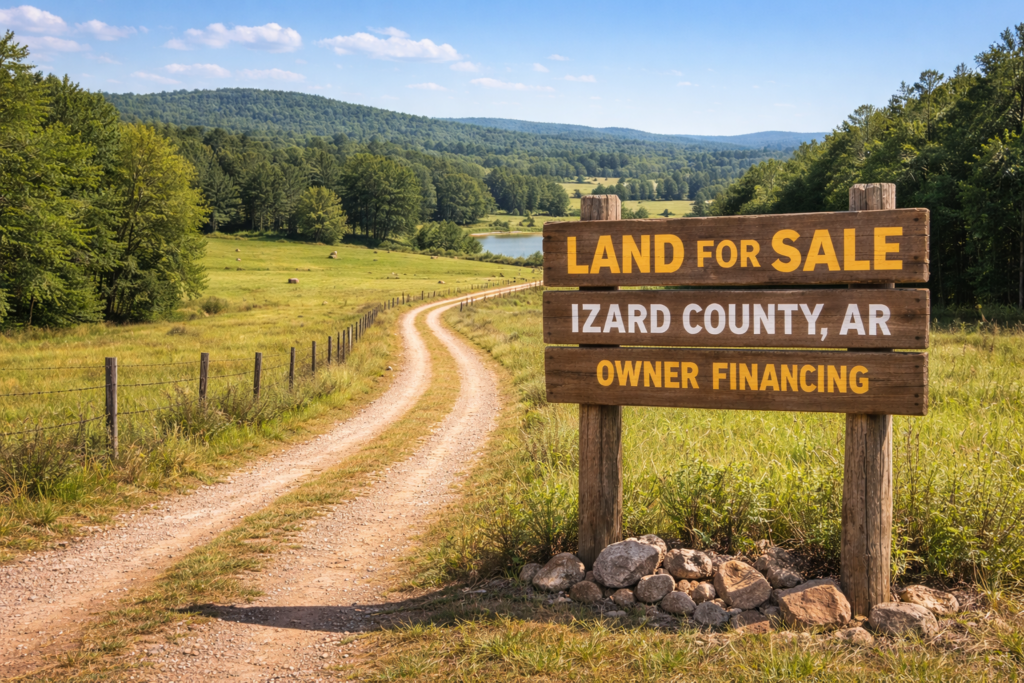
Izard County sits in the north-central Arkansas Ozarks, where rolling hills meet hardwood forests and spring-fed creeks cut through limestone valleys. With a population under 14,000 spread across 580 square miles, the county offers something increasingly rare: affordable rural land where you can actually do what you want with your property.
This isn’t suburban Arkansas with neighborhood covenants and mandatory lawn maintenance. Izard County attracts buyers who want timber, pasture, hunting land, or a place to build without asking permission from an architectural review board. The Ozark landscape delivers four distinct seasons, abundant water, and terrain that supports everything from cattle grazing to off-grid homesteading.
Terra Flow Capital specializes in connecting buyers with affordable rural parcels across Arkansas. We maintain active inventory in Izard County and work with buyers who want honest information, simple transactions, and owner financing options that don’t require bank approval.
Izard County draws buyers looking for a specific combination of affordability, freedom, and natural beauty that’s harder to find each year.
Genuine affordability. While land prices have climbed across much of the South, Izard County remains accessible to buyers without six-figure budgets. Parcels routinely sell for under $5,000, and owner financing makes monthly payments lower than a typical car payment.
Minimal restrictions on land use. Arkansas generally takes a hands-off approach to rural land regulation, and Izard County exemplifies this philosophy. Outside incorporated towns, you’ll find few zoning restrictions limiting what you can build or how you can use your property. No HOA tells you what color your barn can be or whether you can park your RV on your own land.
Water abundance. Unlike the arid Southwest, the Ozarks receive 45 to 50 inches of annual precipitation. Springs emerge from limestone formations throughout the county. Creeks and streams cross many properties. For buyers concerned about water access, Izard County offers natural advantages that desert states simply can’t match.
Four-season climate. The Ozark climate delivers genuine seasons without extreme conditions. Summers are warm but not brutal. Winters bring occasional snow without months of frozen ground. Spring and fall offer extended mild periods ideal for outdoor work and recreation.
Timber and natural resources. Much of Izard County is forested with oak, hickory, pine, and cedar. Timber has value, whether you’re harvesting for income, clearing for pasture, or simply enjoying woodland property. The forests also support abundant wildlife for hunters.
Izard County’s terrain varies from river bottoms to Ozark ridges, and different areas suit different buyers.
Melbourne and Surrounding Area
Melbourne serves as the county seat and largest town, with a population around 1,800. The area immediately surrounding Melbourne offers the best access to services including grocery stores, fuel, hardware supplies, and medical care. Land near Melbourne typically commands higher prices due to convenience, but parcels just a few miles out remain affordable while keeping town amenities accessible.
Calico Rock and the White River Corridor
The eastern edge of Izard County borders the White River, one of Arkansas’s premier trout fisheries. Calico Rock, a small town built into the bluffs above the river, attracts buyers interested in fishing access and river recreation. Land in this corridor tends toward steeper terrain with dramatic views but more challenging building sites.
Franklin and Western Izard County
The western portions of the county around Franklin offer more rolling terrain with a mix of pasture and timber. This area attracts buyers interested in livestock, hobby farming, or larger acreage parcels. Land prices in western Izard County often run lower than areas closer to Melbourne or the White River.
Ozark Highlands and Ridgetop Properties
Throughout the county, ridgetop properties offer views, breezes, and often better solar exposure. Valley properties provide water access, flatter terrain, and typically better soil. Your intended use should guide which terrain type makes sense. Homesteaders often prefer valleys for gardening and water. Hunters and those prioritizing views tend toward ridges.
Buyers purchase Izard County land for diverse purposes. Here’s what we commonly see:
Homesteading and self-sufficiency. The Ozarks have a long homesteading tradition, and Izard County continues attracting buyers who want to grow food, raise livestock, and reduce dependence on external systems. The climate supports extensive gardening, the terrain accommodates livestock, and the regulatory environment doesn’t obstruct self-sufficient living.
Hunting and recreation nearby. Whitetail deer, turkey, and small game are abundant throughout Izard County. Many buyers purchase wooded parcels specifically for hunting access, either for personal use or as weekend retreats from urban areas. Little Rock sits about two hours south, making Izard County accessible for weekend trips.
Retirement and second homes. Buyers from Texas, Louisiana, and other southern states discover they can own Ozark land for less than a used car costs. Some build retirement homes. Others establish weekend retreats they’ll eventually occupy full-time. The low purchase prices and minimal property taxes make carrying land for future use financially practical.
Timber investment. Forested Izard County land produces income potential through selective timber harvesting. Buyers with longer time horizons purchase wooded parcels, manage timber growth, and harvest periodically. Combined with recreational use, timber properties can generate returns while you enjoy the land.
Off-grid living. Arkansas has no statewide building codes for rural unincorporated areas. Izard County’s approach to regulation allows alternative building methods, solar installations, rainwater harvesting, and unconventional structures that wouldn’t be permitted in more regulated jurisdictions. For buyers committed to off-grid living, few states offer more practical freedom than Arkansas.
RV and camping retreats. Unlike jurisdictions that limit how long you can camp on your own property, Izard County generally allows extended camping and RV use on private land. Buyers who want land for recreational camping, seasonal use, or as a base while building find the county accommodating.
Traditional lenders rarely finance raw land purchases, particularly for amounts under $50,000. This creates a gap that owner financing fills.
Terra Flow Capital offers straightforward owner financing on our Izard County inventory:
Low down payments. Most parcels require down payments starting around $200 to $500, making land ownership immediately accessible.
Affordable monthly payments. We structure financing with fixed monthly payments typically ranging from $99 to $350 depending on purchase price and terms.
No credit checks. We don’t pull credit reports or require bank approval. Your ability to make payments determines eligibility, not your credit score.
No prepayment penalties. Pay off early anytime without fees or penalties.
Clear ownership path. Complete your payments and receive the deed. Simple.
This model works because it removes barriers that prevent buyers from purchasing land. You don’t need perfect credit. You don’t need $20,000 in cash. You need a down payment and the ability to make monthly payments.
Smart buyers verify key factors before purchasing. Here’s what matters for Izard County properties:
Legal access. Confirm your parcel has documented legal access. This might be county road frontage, a recorded easement, or deeded right-of-way. Don’t assume a visible road constitutes legal access—verify with documentation.
Terrain and buildability. Ozark terrain ranges from relatively flat river bottoms to steep hillsides. Understand the topography of your specific parcel. Steep slopes complicate building and increase construction costs. Flatter areas are easier to develop but may have different soil and drainage characteristics.
Timber and vegetation. Know what’s growing on the property. Mature timber has value. Cleared land is easier to develop but may lack privacy. Dense undergrowth might indicate wet areas or past disturbance.
Utilities. Most rural Izard County land doesn’t have utilities at the property line. Understand what’s available: How far is the nearest power line? Is rural water district service available? What are the costs to extend utilities versus going off-grid?
Septic feasibility. Arkansas requires approved septic systems for permanent dwellings. Soil type affects which septic systems work and their cost. Some properties have soil conditions requiring engineered systems rather than conventional septic, which adds expense.
Flood zones. Valley properties and land near creeks may fall within FEMA flood zones. This affects building locations, insurance requirements, and financing options. Verify flood zone status before purchasing.
Property taxes. Arkansas property taxes on rural land are generally low. Verify current tax amounts and confirm no delinquent taxes exist.
We provide detailed property reports for every parcel we sell, covering access, terrain, utilities, and known issues.
Purchasing land from us follows a simple process:
Step 1: Request available inventory. We’ll send our current list of Izard County parcels with location details, pricing, photos, and property information.
Step 2: Identify your property. Review listings and select a parcel that meets your needs. Ask questions—we provide straightforward answers.
Step 3: Choose payment terms. Pay cash for a discount, or select owner financing with a down payment and monthly terms that fit your budget.
Step 4: Sign the purchase agreement. We prepare the paperwork. You review, sign, and return it.
Step 5: Make payments (if financing). Set up automatic payments or pay manually each month until the balance is complete.
Step 6: Receive your deed. For cash purchases, you receive the deed after closing. For financed purchases, the deed transfers when you complete payments.
No real estate agents taking commissions. No bank approval processes. No complicated procedures.
Arkansas takes a relatively hands-off approach to rural land regulation, but understanding what rules exist helps you plan effectively.
Building codes. Arkansas has no statewide building code for residential construction in unincorporated areas. Individual counties can adopt codes, but most rural Arkansas counties, including Izard, have minimal building regulation outside incorporated towns. This means you have flexibility in construction methods, materials, and design that wouldn’t exist in code-enforced states.
Septic systems. The Arkansas Department of Health regulates on-site wastewater systems. Before installing a septic system, you’ll need a site evaluation and permit. The type of system required depends on soil conditions, lot size, and intended use. Conventional septic systems work on many properties. Others may require alternative systems.
Manufactured homes. Arkansas permits manufactured homes on private rural land without the restrictions many states impose. You can place a manufactured home on your Izard County property without special permits in most unincorporated areas, though you’ll still need appropriate septic and utility connections.
Tiny homes and alternative structures. Arkansas’s lack of statewide building codes creates opportunity for tiny homes, converted shipping containers, and other alternative structures that face obstacles elsewhere. On unrestricted rural land, your structure choices are largely your own.
Agricultural use. Land used for agricultural purposes may qualify for preferential tax treatment. Arkansas has programs that reduce property taxes on land actively used for farming, timber production, or other agricultural purposes.
The Ozark forests support diverse wildlife, and hunting represents a primary reason many buyers purchase Izard County land.
Whitetail deer. The Ozarks hold strong deer populations, and Izard County lies within Arkansas’s productive deer hunting territory. Many landowners manage their properties specifically for deer, using food plots, selective timber harvest, and habitat improvements to attract and hold deer.
Turkey. Wild turkeys thrive in the oak-hickory forests covering much of Izard County. Both spring and fall turkey seasons draw hunters, and private land ownership gives you hunting access without competing for public land spots.
Small game. Squirrel and rabbit populations remain strong in Ozark forests. Small game hunting offers extended seasons and provides a reason to spend time on your property year-round.
Predators and furbearers. Coyotes, bobcats, foxes, and raccoons inhabit the county. Trappers find opportunities, and predator management on properties with livestock or deer management goals is common.
Fishing. While not directly wildlife, the White River’s trout fishery deserves mention. The cold water released from Bull Shoals Dam creates one of the country’s best trout streams, and proximity to this fishery adds value to eastern Izard County properties.
The Ozark climate differs substantially from both the Deep South and the upper Midwest, offering a moderate four-season environment.
Spring (March through May). Ozark springs arrive early and green. Temperatures climb from the 50s in March to the 70s and low 80s by May. Spring brings the most rainfall, with frequent thunderstorms that green up pastures and fill creeks. Tornado risk exists but is lower than in western Arkansas or Oklahoma.
Summer (June through August). Summers are warm with daytime highs typically in the upper 80s to low 90s. Humidity is present but less oppressive than in lowland Arkansas or the Gulf states. Elevation helps—Izard County sits between 500 and 1,500 feet, enough to moderate summer heat. Evening temperatures usually drop into the 60s, making nights comfortable.
Fall (September through November). Ozark autumns are spectacular. Hardwood forests turn color through October, and the extended mild weather makes fall ideal for outdoor work and hunting season. First frost typically arrives in late October or November.
Winter (December through February). Winters are genuine but not severe. Average January highs reach the mid-40s with lows in the mid-20s. Snow falls several times each winter, occasionally accumulating significantly, but rarely persists for extended periods. The ground doesn’t freeze deeply, allowing year-round construction in most years.
Annual precipitation. Izard County receives approximately 45 to 50 inches of rainfall annually, distributed throughout the year with peaks in spring. This abundant moisture supports forests, fills wells, and makes water access far easier than in arid western states.
Yes, Izard County is exceptionally accommodating for off-grid living. Arkansas has no statewide building codes for rural unincorporated areas, which means many of the regulatory obstacles that block off-grid construction in other states simply don’t exist here. You can install solar panels without permits in most situations. Rainwater harvesting is legal and practical given the 45+ inches of annual rainfall. Composting toilets and alternative wastewater systems face fewer restrictions than in heavily regulated states. The abundant groundwater means wells are typically affordable to drill, with depths often ranging from 100 to 300 feet rather than the 500+ feet common in arid states. Many properties include springs that can provide gravity-fed water without pumping costs. The challenges for off-grid living in Izard County are practical rather than regulatory. You’ll need to plan for water, power, and waste management, but the county won’t prevent you from implementing unconventional solutions. Many successful off-grid homesteads exist throughout the Ozarks, and the region has an established community of people living self-sufficiently. If you’re comparing states for off-grid potential, Arkansas—and specifically counties like Izard with minimal regulation—ranks among the most favorable in the country.
When we describe Izard County land as unrestricted, we mean the property has no private deed restrictions, HOA covenants, or architectural guidelines limiting how you use it. This stands in sharp contrast to subdivision property where pages of rules govern everything from fence heights to the color of your outbuildings to whether you can keep chickens. On unrestricted Izard County land, those private restrictions don’t exist. You won’t pay HOA fees. You won’t submit building plans to a review committee. You won’t receive violation notices for parking your boat in your yard. Government regulations still apply, but they’re minimal in rural Arkansas. The state has no residential building code for unincorporated areas. The county doesn’t regulate structure types or impose minimum square footage requirements. You’ll need proper septic if you’re building a dwelling, and state environmental regulations protect waterways, but the practical freedom is substantial. You can build a cabin, place a manufactured home, construct a barn with living quarters, set up a tiny home, park an RV, or camp in a tent. You can keep livestock without permits. You can hunt on your own land without asking permission. You can start a small farm operation without zoning approval. The term “unrestricted” isn’t a legal guarantee that no rules apply anywhere. It means the property itself carries no private covenants limiting your use, and the governmental regulations that do apply are minimal compared to most of the country.
Izard County remains one of Arkansas’s more affordable rural land markets. Raw land prices typically range from $6,000 to $8,000+ per acre depending on location, access, terrain, timber, and water features. Smaller parcels in the 1 to 5 acre range commonly sell for $3,000 to $15,000 total. Larger parcels of 10 to 40 acres might range from $20,000 to $80,000. Premium properties with White River frontage, exceptional views, or significant improvements command higher prices. Our inventory focuses on affordable parcels, typically ranging from $3,000 to $25,000, with most properties falling between $5,000 and $15,000. These prices reflect raw land without significant improvements—the baseline entry point for land ownership rather than developed property. Property taxes on unimproved rural land in Arkansas are remarkably low. Annual taxes on a $10,000 parcel might run $50 to $150 depending on assessed value and location. This minimal carrying cost makes holding land financially practical whether you’re planning immediate use, gradual development, or long-term investment. The combination of low purchase prices, available owner financing, and minimal annual taxes puts Izard County land within reach for buyers who might assume land ownership is beyond their budget.
Building requirements in unincorporated Izard County are minimal compared to most jurisdictions. Arkansas has no statewide residential building code, and Izard County hasn’t adopted extensive local codes for rural areas. This means you have flexibility in construction methods, materials, and design that simply doesn’t exist in code-enforced areas. For practical purposes, building a home requires addressing two main concerns: wastewater and utilities. The Arkansas Department of Health requires approved septic systems for dwellings. You’ll need a site evaluation and permit before installing septic. The type of system depends on your soil conditions and property characteristics—conventional systems work on many sites, while others may require alternative treatment systems. If you’re connecting to grid electricity, you’ll work with the local utility and need to meet their connection requirements. For off-grid power, there’s typically no permit process for solar installations in rural areas. Manufactured homes can be placed on rural land without special permits, though you’ll still need septic and any required utility connections. Tiny homes, cabins, and alternative structures face fewer obstacles than in regulated jurisdictions. The practical implication is that you can build what you want, how you want, as long as you handle wastewater appropriately. No inspectors will check whether your framing meets code. No officials will require engineered plans for a simple cabin. This freedom comes with responsibility—you’re ensuring your own construction quality rather than relying on code enforcement—but for capable owner-builders, it’s a significant advantage.
Water access in Izard County is generally easier and more affordable than in many parts of the country. The Ozark region sits on limestone geology that creates productive aquifers, and well depths typically range from 100 to 300 feet—considerably shallower than wells in arid western states. Well drilling costs in Arkansas typically run $15 to $35 per foot depending on the driller and ground conditions. A 200-foot well might cost $4,000 to $8,000 for drilling alone. Add the pump, pressure tank, electrical connection, and basic plumbing, and a complete well system often runs $8,000 to $15,000. While not cheap, this is substantially less than the $25,000 to $40,000 or more required for deep wells in some Arizona or New Mexico locations. Many Izard County properties have additional water advantages. Springs are common throughout the Ozarks, and properties with spring access can have gravity-fed water without pumping costs. Creeks cross numerous properties, providing livestock water and aesthetic value. The 45+ inches of annual rainfall makes rainwater harvesting practical as a primary or supplemental water source. Arkansas requires a water well permit from the state, but the process is straightforward for domestic wells. Unlike some western states with complex water rights systems, Arkansas groundwater regulations are relatively simple for individual landowners drilling wells for household use. Before purchasing any property where water access matters, investigate the specific water situation in that area. Well depths, water quality, and spring availability vary by location. We provide water information for properties in our inventory.
Yes, Arkansas permits manufactured homes on private rural land without the restrictions many states impose. In unincorporated Izard County, you can place a manufactured home on your property without special permits, zoning approval, or age restrictions that exist in many jurisdictions. The practical requirements involve setup and utilities rather than permission. You’ll need to install the home properly (usually requiring a licensed installer for newer manufactured homes), connect to septic or install a new system, and arrange utility connections or off-grid alternatives. HUD-code manufactured homes (built after 1976 to federal standards) are treated as permanent housing and can be titled as real property attached to the land. Older mobile homes may face some limitations for financing purposes but are generally permitted on private rural land. This flexibility makes Izard County attractive for buyers who want affordable housing options. A manufactured home on owned land can provide comfortable living at a fraction of the cost of site-built construction, and without the monthly lot rent that manufactured home communities charge.
Land investment returns depend on time horizon, location specifics, and broader market trends. Izard County offers characteristics that attract investment-minded buyers: low purchase prices, minimal carrying costs, and location in a region seeing gradual population shifts. Northern Arkansas has experienced modest but steady growth as remote work enables people to leave expensive metros. The Ozarks attract retirees, outdoor enthusiasts, and buyers seeking affordable rural property. This demand creates gradual upward pressure on land values, particularly for parcels with good access, usable terrain, or desirable features. The investment case involves buying at today’s prices and holding as regional demand grows. With property taxes often under $100 annually, holding costs are minimal. You can use and enjoy the land while waiting for appreciation. However, rural Izard County isn’t likely to see rapid appreciation. This isn’t land on the suburban fringe of a growing city. Returns, if they come, accumulate over years rather than months. The low entry cost and minimal carrying expenses make patient holding practical. If you’re evaluating land purely as investment, consider the specific parcel characteristics. Properties with good road access, gentle terrain, and proximity to services have more appreciation potential than remote parcels with difficult access. The best investment properties often work as something you’ll enjoy using while holding for long-term value growth.
Much of Izard County is forested, and timber represents both an asset and a management consideration. Oak and hickory dominate the hardwood stands, with pine present in some areas. Mature timber has market value, and selective harvesting can generate income while maintaining forest cover. For buyers interested in timber value, understanding what’s on a property matters. Mature sawlog-quality hardwoods are more valuable than young regrowth or pulpwood-grade timber. Species composition, tree size, and accessibility for logging equipment all affect timber value. If you’re purchasing specifically for timber investment, consider having a forester evaluate the property. Professional timber inventory provides accurate value estimates and management recommendations. For a few hundred dollars, you’ll know exactly what you’re buying. Many buyers aren’t primarily interested in timber income but appreciate the privacy, wildlife habitat, and aesthetic value forests provide. Wooded land can be gradually cleared for building sites, pasture, or gardens while maintaining timber on the remainder. Arkansas has programs that reduce property taxes on land managed for timber production. If you’re holding wooded land long-term, investigating these programs can reduce carrying costs while you wait for timber to mature.
Utility availability varies by location, and extending service to unserved properties involves costs you should understand before purchasing. Electric service in rural Izard County comes from electric cooperatives (primarily North Arkansas Electric Cooperative) rather than investor-owned utilities. Cooperatives generally extend service to members, but you may pay for line extension beyond a certain distance from existing infrastructure. The cost to extend power lines varies significantly. If the nearest power is across the road, connection costs might be modest. If the nearest power is a mile away, extension costs can run into thousands of dollars. Before purchasing property where grid power matters, contact the serving cooperative for extension cost estimates. Internet options have improved dramatically with satellite services like Starlink. Many rural properties that previously had no viable internet option can now get functional high-speed service. This changes the equation for remote properties and remote work situations. Rural water districts exist in some areas of Izard County, providing treated water to properties within their service boundaries. Most rural land, however, relies on wells for water. Verify whether rural water is available if well drilling seems undesirable. For buyers planning off-grid properties, utility availability becomes less relevant. Solar power with battery storage, rainwater or well water, and cellular or satellite internet can provide functional infrastructure without grid connections.
Unincorporated Izard County has minimal zoning regulation. Unlike urban areas with detailed zoning maps dictating what you can build and where, rural Izard County generally doesn’t impose these restrictions on private land. You won’t find residential zones, commercial zones, or agricultural zones determining what activities are permitted on your property. This lack of zoning means you can use your land flexibly. Build a home, operate a small business, keep livestock, or combine uses—the county doesn’t require permits or approval for most activities that zoning would regulate elsewhere. The flip side of minimal zoning is that your neighbors have similar freedom. Someone could theoretically start a noisy operation on adjacent property without zoning restrictions preventing it. In practice, the low population density and rural character of Izard County means this rarely creates problems. Most people buying rural Ozark land want the same things: privacy, peace, and freedom to use their property. Land within incorporated towns (Melbourne, Calico Rock, etc.) may have local regulations. If you’re buying property within town limits, verify what rules apply. For properties in unincorporated areas—which is most of the county—zoning isn’t a significant concern.
Boundary verification typically involves reviewing the legal description against physical markers and, when warranted, obtaining a professional survey. For rural land, corner markers may be iron pins, fence corners, or natural features referenced in the legal description. Legal access verification is separate from boundary questions. Confirm your parcel has documented legal access through county road frontage, recorded easement, or deeded right-of-way. Review the deed and any referenced easement documents. A title search reveals recorded access rights. For properties we sell, we verify legal access and provide documentation. We describe access clearly—whether it’s county road frontage, recorded easement, or otherwise. We don’t sell landlocked properties without disclosing the access situation. If you’re purchasing from another seller and access is questionable, consider title insurance that covers access issues, or hire an attorney to verify access rights before closing. A few hundred dollars spent on verification beats discovering access problems after you own the property. Professional surveys cost $400 to $1,500 or more depending on property size and complexity. For high-value properties or situations where boundary location matters significantly, surveys provide definitive answers. For lower-priced rural properties with clear legal descriptions and visible boundaries, buyers sometimes skip formal surveys while accepting some uncertainty.
Izard County offers diverse hunting opportunities reflecting its Ozark location. Whitetail deer are the primary draw, with the region supporting healthy deer populations. Private land ownership means you control hunting access—no competing with crowds on public land, no lottery drawings for permits. Arkansas has generous deer seasons, typically running from September through February when combining archery, muzzleloader, and modern gun seasons. Landowners can manage properties specifically for deer through food plots, mineral sites, selective timber harvest, and habitat improvements. Many buyers purchase Izard County land specifically for deer hunting. Wild turkeys thrive in Ozark hardwoods. Spring turkey season draws hunters seeking gobblers, and the region produces quality birds. Turkey hunting provides another reason to spend time on your property during the year. Small game including squirrels and rabbits remain abundant in forested areas. While less glamorous than deer hunting, small game offers extended seasons and additional hunting opportunity. The White River and tributary streams support fishing, including the famous trout fishery below Bull Shoals Dam. Properties near the river provide fishing access, though not direct hunting opportunities on the water itself. For hunters, owning Izard County land means guaranteed access to huntable habitat. You decide who hunts, when, and how the land is managed. That control—plus the region’s strong wildlife populations—makes land ownership compelling for serious hunters.
Whether you’re planning an off-grid homestead, seeking a recreational retreat, or building a land portfolio, we can help you find the right property at a price that works.